explore

2026

Don't Despair and Don't Get Your Hopes Up: The Future Will Be Exactly the Same
Flying cars never arrived, but boring infrastructures did. How maintenance, mundane futures, and real boredom reveal more about what's coming than any technological breakthrough.
Flying cars never arrived, but boring infrastructures did. How maintenance, mundane futures, and real boredom reveal more about what's coming than any technological breakthrough.
September
2025
2025
↓explore
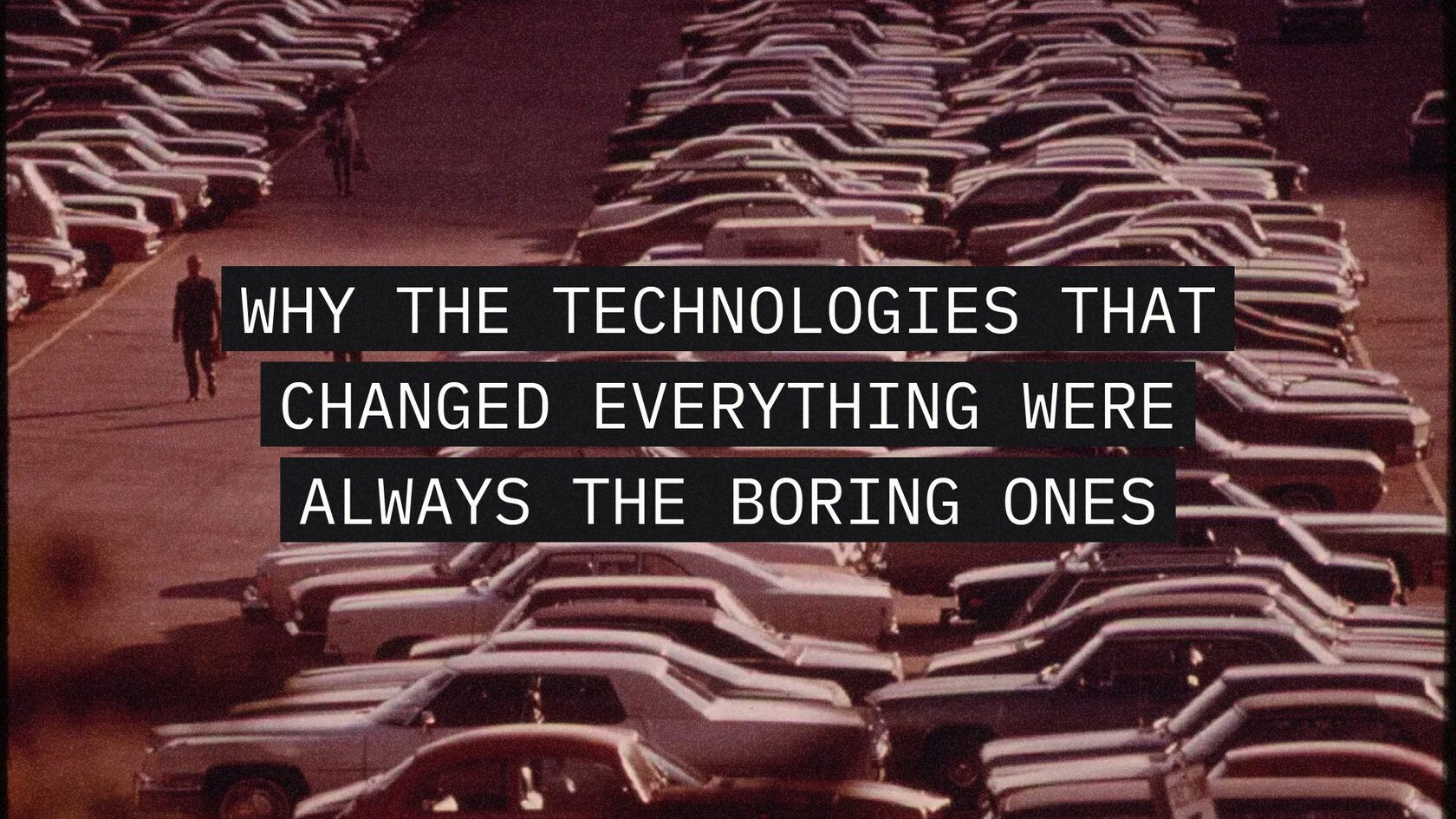
Don't Despair and Don't Get Your Hopes Up: The Future Will Be Exactly the Same
When you look at 2025 through the eyes of people from the last century, it feels awkward. The future was supposed to be different.
We expected flying cars, skyway highways, cities with moving sidewalks, climate domes, and household robots. We expected regular lunar flights, Martian settlements, orbital stations where people lived as they do on Earth. We expected free energy and atomic miracles that would permanently resolve the question of resources.
Tech-obsessed modernists envisioned a future in which technology would deliver humanity the best of all possible futures.
And here we are, in that future.
To be fair, some of it did come true. But are we, thanks to these technologies, living in the best of all futures? Well, it’s not quite that simple.
The problem is not that no breakthrough technologies have appeared. The problem is how we feel among them.
Over the course of a century, the public image of technological breakthroughs has lost something fundamentally important — the sense that they serve some purpose for all of humanity. Today, it seems that the only people still capable of speaking about technology in the language of universal salvation are a handful of techno-radicals from Silicon Valley — and even then, only the ones who haven’t yet daydreamed their way to a Series A.
Sense of wonder is one of the central concepts in twentieth-century science fiction theory. It denoted a particular affect that science fiction was supposed to evoke in the reader: the sensation of touching something far more complex and magnificent, an awe before the scale of the future.
A new iPhone version, another VPN getting blocked, a new release of ChatGPT, push notifications from colleagues, yet another update to a banking app — it is hard to seriously argue that any of this feels like wonder.
Does this mean that we, as humanity, made an error somewhere in designing the future? Or was the mistake in expecting the future to deliver special effects in the first place?
Or perhaps mature technological progress is predictably boring: wonder inevitably turns into a service, and the fantastic becomes infrastructure that ceases to amaze at precisely the moment it… starts working reliably.
The Deadlock of the Eternal Present
When Lauren Berlant (1), scholar and cultural theorist, attempts to describe how the world feels to the contemporary subject, she proposes the concept of impasse — a deadlock.
There is too much world, yet it is too incomprehensible. Moving through it requires oscillating between distraction and hypervigilance.
On one hand, we need to scatter our attention as widely as possible, passively absorbing nearly all the data the world offloads onto us — because it is impossible to know in advance what will turn out to be needed later. On the other hand, we must remain constantly alert: scanning for either new threats or clues that might finally clarify what is actually happening and what to do next.
For Berlant, the state of impasse is the only possible mode of existence under conditions of crisis ordinariness — a state of affairs in which crisis becomes the habitual background rather than the exception. Formally, we still keep the markers of the “good life” in our line of sight: stable employment, social safety nets, data privacy, meritocracy. But they feel increasingly unattainable.
Impasse is not the feeling of the end of the world. It is the sticky sensation of being stuck in a reality where the systems that are supposed to work do not work reliably, no new stable solutions emerge, and yet life must somehow go on. Berlant’s contemporary subject is one frustrated by being trapped in an endless present.
The boring moments of everyday life sharpen the feeling of impasse with particular intensity — it is in them that the illusion of control over one’s own life is most visibly exposed.
It is genuinely hard to feel like the main character during rush hour on the subway: that is where the vulnerability before how reality is actually structured hits hardest. In such moments, the hope of personal autonomy collapses, and all that remains is to confront the world as it is — without the ability to repackage it into a convenient, controllable routine.
(1) Lauren Berlant, Cruel Optimism (2011)
Top Unexpected Anime Endings: Capitalists Learn to Be Bored Too
In the commercial sector, “boring industries” refers to segments that entrepreneurs and investors perceive as unglamorous and non-innovative: logistics and warehouse infrastructure, construction and facility management, manufacturing and processing, utilities and transportation services, waste disposal, accounting, and back-office operational services.
This is the foundational infrastructure on which the possibility of everything else — the more “interesting” and visible products — depends.
In recent years, capital’s attention has been gradually shifting in this direction: against the backdrop of an overheated tech sector, investors are increasingly viewing infrastructure, operational, and utilitarian industries as more resilient and undervalued growth opportunities.
This shift is driven not only by the search for new sources of profit, but also by a growing awareness of the vulnerability of supply chains and critical systems. The pandemic, geopolitical tensions, and climate change have made it abundantly clear that it is precisely the “boring” infrastructures that determine the resilience of economies and the feasibility of even the most ambitious projects.
The most vivid example is the intensifying conversation around AI infrastructure. We are finally beginning to publicly articulate the material conditions that enable it to function: chips, data centers, power grids, cooling systems, and the labor of people who keep all of it operational every single day.
According to recent Goldman Sachs estimates, data centers’ share of U.S. energy consumption could grow from approximately 3% to around 8% by 2030; total electricity demand from computing systems will increase by more than 175%; and the aggregate capital required for the energy transition in the coming decades is measured in tens of trillions of dollars. In this context, the ability to rapidly connect new capacity — energy, network, infrastructure — becomes a key prerequisite for deploying AI systems.
And it is precisely about this infrastructure that we have an increasing number of questions: Who manufactures the chips and why are they so expensive? Where are the data centers located and what is their scale? How much energy do they consume and from what sources? Who annotates the data for LLMs, where do these people live, and how much do they earn?
These questions are not mere curiosity. They express a growing anxiety about how sustainable and equitable the infrastructure is that is needed to furnish the future with better technologies. It has become more evident that the deployment of AI is not only a matter of algorithms and their training, but also a matter of access to resources: to electricity, water for cooling, rare earth metals, and cheap labor.
It is therefore unsurprising that alongside private capital, the state budgets of the world’s largest economies have also shifted sharply toward infrastructure, energy, and defense. The vulnerability of long supply chains, geopolitical instability, and growing computational demand have transformed infrastructure in the eyes of governments from a routine budget line item into a matter of national security.
From this perspective, infrastructure ceases to be a necessary but boring backdrop for the future and becomes its strategic precondition. It is the infrastructures of the present that determine what the future will look like — and who within it will be more protected and who more vulnerable.
On a personal level, when we encounter the boring, we are usually encountering precisely these infrastructures. We sit in traffic because of the way an interchange in the city center is designed. We cannot connect to an online meeting because the VPN has gone down again. We wait twenty minutes every morning for the water to heat up because a small boiler simply cannot handle the load of a high-rise building.
As frustrating as it may be, it is precisely these boring moments that spoil the future for us: they reveal which systems will continue to structure our lives going forward.
The Future Will Be… Ordinary
When it comes to planning the future — personal, collective, or corporate — anthropologist Sarah Pink suggests looking first and foremost at the boring, mundane level of life. For her, the key object of foresight and trendwatching is mundane futures — the everyday, the ordinary futures yet to come.
Our best possible future will not arrive solely through technological progress, nor will it consist exclusively of spectacular innovations.
It will, in any case, remain filled with everyday routine actions, the embodied experiences of specific people, and domestic minutiae in which technologies adapt to real life.
A new technology cannot be treated as an agent that transforms society on its own. When a technology enters someone’s everyday life, it is almost always reconfigured by people to fit their own rhythms, constraints, hopes, and ambitions. A person does not simply “adapt” to an innovation — they reinvent it, break it, and use it for purposes it was never intended for.
Today, we rarely think about the future in the language of mundane details of the present: we are more inclined to see the future as the result of major events, scientific breakthroughs, and pivotal historical moments. But in reality, it grows out of the banal infrastructures that already saturate our reality. Out of how people interact with these infrastructures on a daily basis.
Maintenance: The Invisible Support Service
STS (Science, Technology, and Society) is a field of humanistic inquiry that studies how science is produced and how technologies become embedded in society. One of its key concepts is maintenance: the daily labor of keeping infrastructures and devices in working order, of ensuring that technologies can actually function as intended — and not merely look convincing in presentations.
Today, the majority of public conversations about technology are conducted in the language of innovation, through the logic of the “next big thing” — as though the mere appearance of a technology should automatically improve (or complicate) our lives.
But STS research demonstrates time and again the opposite: the durability and real-world impact of technologies is ensured primarily by the invisible labor of their daily servicing, repair, and adaptation to specific conditions. It is this boring, continuous routine of upkeep that determines how exactly technologies will change our lives.
One of the most revealing cases is the research of MIT anthropologist Steven Gonzalez Monserrate, who has studied data centers in New England, Arizona, Puerto Rico, and Singapore. His interest lies not in the work of code, but in the labor of technologists — the people who physically maintain these centers every day. In his descriptions, a data center is not an abstract “cloud” room where the magic of computation takes place, but a vulnerable space whose internal logic tends more toward failure than toward stable operation.
These are warm, noisy facilities requiring constant human presence: temperature and humidity control, the tracking and elimination of “hot spots,” noise monitoring, the replacement of cooling components, and rapid response to any deviation. Monserrate demonstrates that uptime is ensured not by abstract algorithms, but by the embodied routines of specific people: rearranging tiles in raised floors to improve air circulation, reconfiguring hot and cold aisles, manually cooling systems when overheating threatens, maintaining water systems in the tropics, and handling noise complaints from residents in Arizona.
Cloud computing rests on the continuous, often invisible engagement of maintenance specialists — those who stand watch, repair, cool, listen, measure, and quite literally prevent the infrastructure from falling apart.
The future demands care for the boring in the present.
If we follow the logic of STS and view technologies through the lens of maintenance, it becomes apparent that it is precisely the everyday failures, delays, and minor breakdowns that set the real dynamics of technological systems — and, by extension, the contours of how they will behave in the future.
Therefore, if we want to engage in genuinely pragmatic foresight, this everydayness must be taken into account not as an optional backdrop, but as a key condition for constructing any scenarios of the possible future.
It is this everydayness that tells us far more about reality than the technologies themselves: crashes, updates, random app errors, unreliable APIs, endless identity verifications, yet another “sorry for the inconvenience, here’s a promo code for your next delivery.” All of this is not bugs — it is the regular rhythm of how technologies live in the world. And if this rhythm is not accounted for, it is impossible to speak honestly about what kind of future they are capable of building.
In a World of Art Directors, Stay an Ordinary Designer
Futurist and designer Nick Foster developed the Future Mundane framework — an approach to designing the future that is fundamentally oriented toward pragmatic, everyday scenarios rather than utopian or dystopian fantasies. In his logic, new technologies and design solutions almost never replace the old all at once: they embed themselves into the already existing environment, infrastructure, and habits.
It is impossible to create a universal artifact that will seamlessly fit into any person’s routines: objects and interfaces glitch, they need to be reconnected, restarted, repaired, and one must constantly find workarounds. Chargers from different generations of gadgets that are incompatible with one another; app updates that break familiar interfaces; smart devices that stop working when a company discontinues server support. All of this is not bugs delaying the singularity — it is the normal state of the technological world, in which innovations layer onto existing systems rather than replacing them.
This means that design and strategy for a plausible future must account from the outset for “failure” scenarios — the places where technologies and infrastructures misfire and where people must improvise to keep the system in working order.
The present will always be partially broken — and the only question is who bears the costs of those breakdowns and who has the resources to fix them.
The Boring Is Data
Recently, videos went viral on TikTok in which people sit in front of a camera with a timer set for 30+ minutes and do nothing. They are rawdogging boredom. The premise is that this helps restore concentration and reconnect with reality. In short, Gen Z invented meditation. But “rawdogging boredom” is merely another attempt to turn boredom into a manageable resource that can be dosed and deployed to restore productivity. In this way, “boredom” becomes a performance, and we lose touch with reality all over again.
Real boredom works differently. It arises not when we consciously decide to pause, but in moments when everyday life itself commandeers our time.
Real boredom makes the shared infrastructures within which we live visible. When the bus is late, we begin to notice the route network. When the internet goes down, we remember providers and tariffs. When the elevator breaks and we have to walk up to our floor, we discover that it is serviced by a specific company under a specific contract.
Berlant is right: there will be no future. But not because someone took it from us. It is simply (almost) already here — in the form of tired, underfunded, imperfect infrastructures that somehow work every day, somehow break down, and are somehow repaired by someone.
And in order to notice the infrastructures that require change — to bring about a future more acceptable for all of us — it is important to allow real boredom to happen.
The kind that illuminates weak spots, vulnerable points where our shared infrastructure lacks care or is overburdened.
If the future truly will closely resemble the present, then we already have all the source data we need to influence it.
And if we learn to perceive boredom as a signal that tells us about possible futures rather than as an annoyance, we will be able to practice foresight not from fantasies about breakthroughs or catastrophes, but from attentive, slow work with what already exists — with those boring, banal moments that are the first to suggest where exactly we should direct our efforts, if we genuinely want to find our way out of the deadlock.
We expected flying cars, skyway highways, cities with moving sidewalks, climate domes, and household robots. We expected regular lunar flights, Martian settlements, orbital stations where people lived as they do on Earth. We expected free energy and atomic miracles that would permanently resolve the question of resources.
Tech-obsessed modernists envisioned a future in which technology would deliver humanity the best of all possible futures.
And here we are, in that future.
To be fair, some of it did come true. But are we, thanks to these technologies, living in the best of all futures? Well, it’s not quite that simple.
The problem is not that no breakthrough technologies have appeared. The problem is how we feel among them.
Over the course of a century, the public image of technological breakthroughs has lost something fundamentally important — the sense that they serve some purpose for all of humanity. Today, it seems that the only people still capable of speaking about technology in the language of universal salvation are a handful of techno-radicals from Silicon Valley — and even then, only the ones who haven’t yet daydreamed their way to a Series A.
Sense of wonder is one of the central concepts in twentieth-century science fiction theory. It denoted a particular affect that science fiction was supposed to evoke in the reader: the sensation of touching something far more complex and magnificent, an awe before the scale of the future.
A new iPhone version, another VPN getting blocked, a new release of ChatGPT, push notifications from colleagues, yet another update to a banking app — it is hard to seriously argue that any of this feels like wonder.
Does this mean that we, as humanity, made an error somewhere in designing the future? Or was the mistake in expecting the future to deliver special effects in the first place?
Or perhaps mature technological progress is predictably boring: wonder inevitably turns into a service, and the fantastic becomes infrastructure that ceases to amaze at precisely the moment it… starts working reliably.
The Deadlock of the Eternal Present
When Lauren Berlant (1), scholar and cultural theorist, attempts to describe how the world feels to the contemporary subject, she proposes the concept of impasse — a deadlock.
There is too much world, yet it is too incomprehensible. Moving through it requires oscillating between distraction and hypervigilance.
On one hand, we need to scatter our attention as widely as possible, passively absorbing nearly all the data the world offloads onto us — because it is impossible to know in advance what will turn out to be needed later. On the other hand, we must remain constantly alert: scanning for either new threats or clues that might finally clarify what is actually happening and what to do next.
For Berlant, the state of impasse is the only possible mode of existence under conditions of crisis ordinariness — a state of affairs in which crisis becomes the habitual background rather than the exception. Formally, we still keep the markers of the “good life” in our line of sight: stable employment, social safety nets, data privacy, meritocracy. But they feel increasingly unattainable.
Impasse is not the feeling of the end of the world. It is the sticky sensation of being stuck in a reality where the systems that are supposed to work do not work reliably, no new stable solutions emerge, and yet life must somehow go on. Berlant’s contemporary subject is one frustrated by being trapped in an endless present.
The boring moments of everyday life sharpen the feeling of impasse with particular intensity — it is in them that the illusion of control over one’s own life is most visibly exposed.
It is genuinely hard to feel like the main character during rush hour on the subway: that is where the vulnerability before how reality is actually structured hits hardest. In such moments, the hope of personal autonomy collapses, and all that remains is to confront the world as it is — without the ability to repackage it into a convenient, controllable routine.
(1) Lauren Berlant, Cruel Optimism (2011)
Top Unexpected Anime Endings: Capitalists Learn to Be Bored Too
In the commercial sector, “boring industries” refers to segments that entrepreneurs and investors perceive as unglamorous and non-innovative: logistics and warehouse infrastructure, construction and facility management, manufacturing and processing, utilities and transportation services, waste disposal, accounting, and back-office operational services.
This is the foundational infrastructure on which the possibility of everything else — the more “interesting” and visible products — depends.
In recent years, capital’s attention has been gradually shifting in this direction: against the backdrop of an overheated tech sector, investors are increasingly viewing infrastructure, operational, and utilitarian industries as more resilient and undervalued growth opportunities.
This shift is driven not only by the search for new sources of profit, but also by a growing awareness of the vulnerability of supply chains and critical systems. The pandemic, geopolitical tensions, and climate change have made it abundantly clear that it is precisely the “boring” infrastructures that determine the resilience of economies and the feasibility of even the most ambitious projects.
The most vivid example is the intensifying conversation around AI infrastructure. We are finally beginning to publicly articulate the material conditions that enable it to function: chips, data centers, power grids, cooling systems, and the labor of people who keep all of it operational every single day.
According to recent Goldman Sachs estimates, data centers’ share of U.S. energy consumption could grow from approximately 3% to around 8% by 2030; total electricity demand from computing systems will increase by more than 175%; and the aggregate capital required for the energy transition in the coming decades is measured in tens of trillions of dollars. In this context, the ability to rapidly connect new capacity — energy, network, infrastructure — becomes a key prerequisite for deploying AI systems.
And it is precisely about this infrastructure that we have an increasing number of questions: Who manufactures the chips and why are they so expensive? Where are the data centers located and what is their scale? How much energy do they consume and from what sources? Who annotates the data for LLMs, where do these people live, and how much do they earn?
These questions are not mere curiosity. They express a growing anxiety about how sustainable and equitable the infrastructure is that is needed to furnish the future with better technologies. It has become more evident that the deployment of AI is not only a matter of algorithms and their training, but also a matter of access to resources: to electricity, water for cooling, rare earth metals, and cheap labor.
It is therefore unsurprising that alongside private capital, the state budgets of the world’s largest economies have also shifted sharply toward infrastructure, energy, and defense. The vulnerability of long supply chains, geopolitical instability, and growing computational demand have transformed infrastructure in the eyes of governments from a routine budget line item into a matter of national security.
From this perspective, infrastructure ceases to be a necessary but boring backdrop for the future and becomes its strategic precondition. It is the infrastructures of the present that determine what the future will look like — and who within it will be more protected and who more vulnerable.
On a personal level, when we encounter the boring, we are usually encountering precisely these infrastructures. We sit in traffic because of the way an interchange in the city center is designed. We cannot connect to an online meeting because the VPN has gone down again. We wait twenty minutes every morning for the water to heat up because a small boiler simply cannot handle the load of a high-rise building.
As frustrating as it may be, it is precisely these boring moments that spoil the future for us: they reveal which systems will continue to structure our lives going forward.
The Future Will Be… Ordinary
When it comes to planning the future — personal, collective, or corporate — anthropologist Sarah Pink suggests looking first and foremost at the boring, mundane level of life. For her, the key object of foresight and trendwatching is mundane futures — the everyday, the ordinary futures yet to come.
Our best possible future will not arrive solely through technological progress, nor will it consist exclusively of spectacular innovations.
It will, in any case, remain filled with everyday routine actions, the embodied experiences of specific people, and domestic minutiae in which technologies adapt to real life.
A new technology cannot be treated as an agent that transforms society on its own. When a technology enters someone’s everyday life, it is almost always reconfigured by people to fit their own rhythms, constraints, hopes, and ambitions. A person does not simply “adapt” to an innovation — they reinvent it, break it, and use it for purposes it was never intended for.
Today, we rarely think about the future in the language of mundane details of the present: we are more inclined to see the future as the result of major events, scientific breakthroughs, and pivotal historical moments. But in reality, it grows out of the banal infrastructures that already saturate our reality. Out of how people interact with these infrastructures on a daily basis.
Maintenance: The Invisible Support Service
STS (Science, Technology, and Society) is a field of humanistic inquiry that studies how science is produced and how technologies become embedded in society. One of its key concepts is maintenance: the daily labor of keeping infrastructures and devices in working order, of ensuring that technologies can actually function as intended — and not merely look convincing in presentations.
Today, the majority of public conversations about technology are conducted in the language of innovation, through the logic of the “next big thing” — as though the mere appearance of a technology should automatically improve (or complicate) our lives.
But STS research demonstrates time and again the opposite: the durability and real-world impact of technologies is ensured primarily by the invisible labor of their daily servicing, repair, and adaptation to specific conditions. It is this boring, continuous routine of upkeep that determines how exactly technologies will change our lives.
One of the most revealing cases is the research of MIT anthropologist Steven Gonzalez Monserrate, who has studied data centers in New England, Arizona, Puerto Rico, and Singapore. His interest lies not in the work of code, but in the labor of technologists — the people who physically maintain these centers every day. In his descriptions, a data center is not an abstract “cloud” room where the magic of computation takes place, but a vulnerable space whose internal logic tends more toward failure than toward stable operation.
These are warm, noisy facilities requiring constant human presence: temperature and humidity control, the tracking and elimination of “hot spots,” noise monitoring, the replacement of cooling components, and rapid response to any deviation. Monserrate demonstrates that uptime is ensured not by abstract algorithms, but by the embodied routines of specific people: rearranging tiles in raised floors to improve air circulation, reconfiguring hot and cold aisles, manually cooling systems when overheating threatens, maintaining water systems in the tropics, and handling noise complaints from residents in Arizona.
Cloud computing rests on the continuous, often invisible engagement of maintenance specialists — those who stand watch, repair, cool, listen, measure, and quite literally prevent the infrastructure from falling apart.
The future demands care for the boring in the present.
If we follow the logic of STS and view technologies through the lens of maintenance, it becomes apparent that it is precisely the everyday failures, delays, and minor breakdowns that set the real dynamics of technological systems — and, by extension, the contours of how they will behave in the future.
Therefore, if we want to engage in genuinely pragmatic foresight, this everydayness must be taken into account not as an optional backdrop, but as a key condition for constructing any scenarios of the possible future.
It is this everydayness that tells us far more about reality than the technologies themselves: crashes, updates, random app errors, unreliable APIs, endless identity verifications, yet another “sorry for the inconvenience, here’s a promo code for your next delivery.” All of this is not bugs — it is the regular rhythm of how technologies live in the world. And if this rhythm is not accounted for, it is impossible to speak honestly about what kind of future they are capable of building.
In a World of Art Directors, Stay an Ordinary Designer
Futurist and designer Nick Foster developed the Future Mundane framework — an approach to designing the future that is fundamentally oriented toward pragmatic, everyday scenarios rather than utopian or dystopian fantasies. In his logic, new technologies and design solutions almost never replace the old all at once: they embed themselves into the already existing environment, infrastructure, and habits.
It is impossible to create a universal artifact that will seamlessly fit into any person’s routines: objects and interfaces glitch, they need to be reconnected, restarted, repaired, and one must constantly find workarounds. Chargers from different generations of gadgets that are incompatible with one another; app updates that break familiar interfaces; smart devices that stop working when a company discontinues server support. All of this is not bugs delaying the singularity — it is the normal state of the technological world, in which innovations layer onto existing systems rather than replacing them.
This means that design and strategy for a plausible future must account from the outset for “failure” scenarios — the places where technologies and infrastructures misfire and where people must improvise to keep the system in working order.
The present will always be partially broken — and the only question is who bears the costs of those breakdowns and who has the resources to fix them.
The Boring Is Data
Recently, videos went viral on TikTok in which people sit in front of a camera with a timer set for 30+ minutes and do nothing. They are rawdogging boredom. The premise is that this helps restore concentration and reconnect with reality. In short, Gen Z invented meditation. But “rawdogging boredom” is merely another attempt to turn boredom into a manageable resource that can be dosed and deployed to restore productivity. In this way, “boredom” becomes a performance, and we lose touch with reality all over again.
Real boredom works differently. It arises not when we consciously decide to pause, but in moments when everyday life itself commandeers our time.
Real boredom makes the shared infrastructures within which we live visible. When the bus is late, we begin to notice the route network. When the internet goes down, we remember providers and tariffs. When the elevator breaks and we have to walk up to our floor, we discover that it is serviced by a specific company under a specific contract.
Berlant is right: there will be no future. But not because someone took it from us. It is simply (almost) already here — in the form of tired, underfunded, imperfect infrastructures that somehow work every day, somehow break down, and are somehow repaired by someone.
And in order to notice the infrastructures that require change — to bring about a future more acceptable for all of us — it is important to allow real boredom to happen.
The kind that illuminates weak spots, vulnerable points where our shared infrastructure lacks care or is overburdened.
If the future truly will closely resemble the present, then we already have all the source data we need to influence it.
And if we learn to perceive boredom as a signal that tells us about possible futures rather than as an annoyance, we will be able to practice foresight not from fantasies about breakthroughs or catastrophes, but from attentive, slow work with what already exists — with those boring, banal moments that are the first to suggest where exactly we should direct our efforts, if we genuinely want to find our way out of the deadlock.
