Unspoken Futures 2026
A large-scale analysis of 184 global 2026 trend reports — mapping where forecasts agree, where they collide, and what the institutions producing them leave unsaid.
The future is described in hundreds of reports, charts, and forecasts, and almost no one reads them in full. We assembled a corpus of the key 2026 trend and foresight reports, assessed their quality, broke each one into concrete claims about the future, and turned that material into interactive maps. What follows is how we did it, the maps themselves, and the five things the corpus leaves unspoken.
How we built it
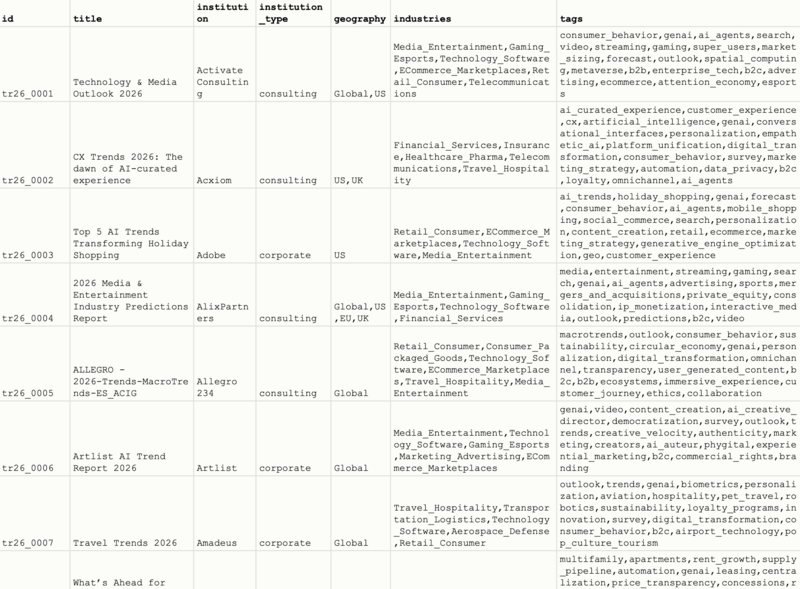
We began with a curated set of trend and foresight reports and audited it for completeness. The result was a catalog of 184 analytical reports for 2026, each carrying standardized metadata: publisher, geographic scope, industry focus, and thematic tags. Both the metadata table and the underlying folder of reports are open, compiled by Amy Daroukakis, Ci En Lee, Gonzalo Gregori, and Iolanda Carvalho.
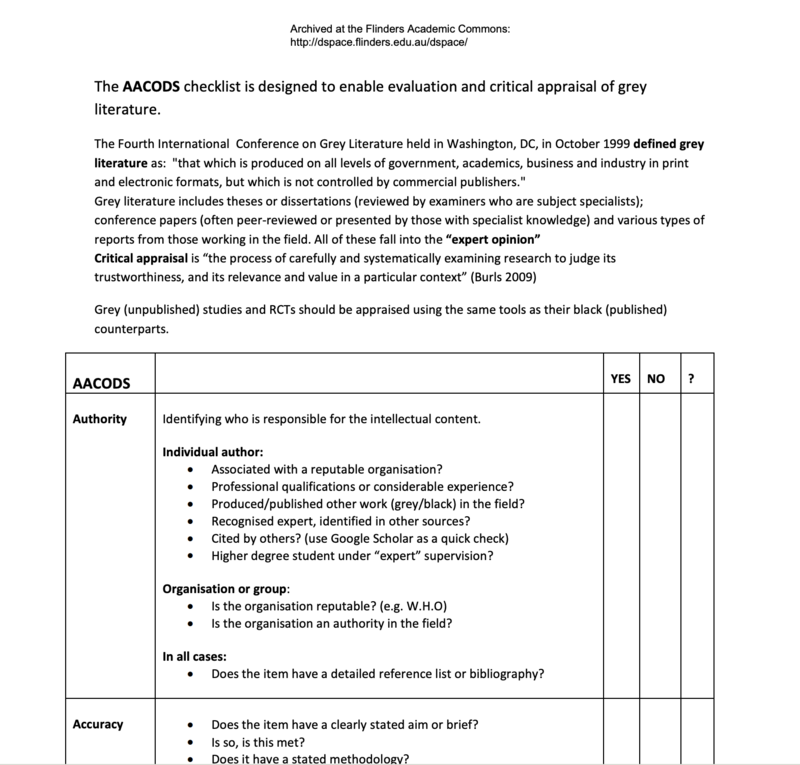
Every report was scored with the AACODS framework for grey-literature quality, on Authority, Accuracy, Coverage, and Objectivity. Only the strongest sources moved forward. We then decomposed each one into claims about the future, formulated as "what will change / what will happen" and tagged with a time horizon, extracting 10 to 20 per report. Data was captured with Gemini 3 Flash and Heptabase, then normalized by hand through predefined dictionaries, with a working document per report so every claim could be traced back to its source.
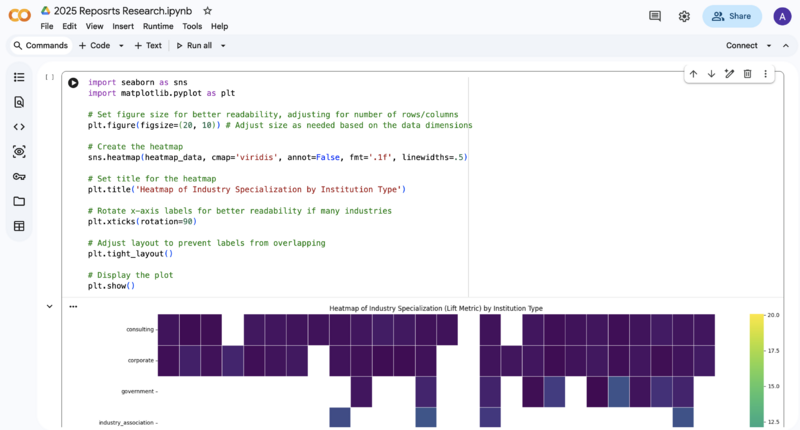
Visualizations were built iteratively: rough prototypes in Google Colab to validate the logic against the underlying data, then interactive web versions built with Claude Code. Across the corpus this produced 420 extracted claims, which the maps below render in three different ways.
The maps
Each map reads the same 420 claims from a different angle. They are fully interactive — filter, hover, and zoom to follow a theme across topics and time horizons. Each one is embedded below; open any map fullscreen for more room.
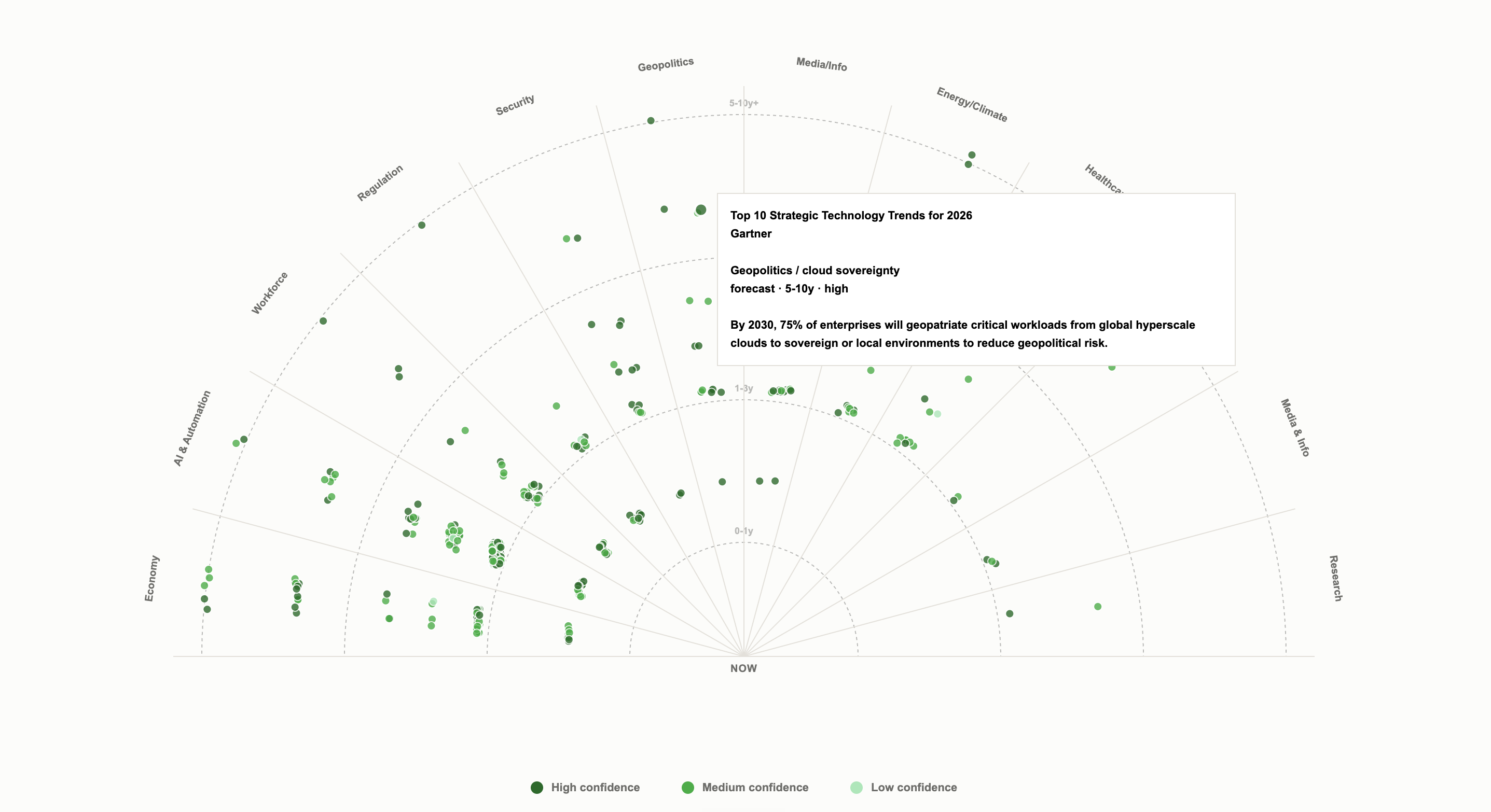
02.01Trend Radar
Every point is one claim. The sector shows its topic, distance from the center shows its time horizon (from "now / 0–1 years" out to 5–10+ years), and color shows source confidence. Denser clusters mark themes that sources return to most often.
02.02Consensus vs. Contention
Each point is a cluster of similar claims. The horizontal axis is consensus, from contested on the left to settled agreement on the right; the vertical axis is expected impact. Two zones emerge: Mainstream Futures (high impact, high consensus) and Contested Futures (high impact, low consensus). Eleven clusters fell into the first, nine into the second.
02.03Pressure Roadmaps
Two timelines — one for organizations, one for individuals — showing which pressures recur across reports and when sources expect them to land. Five columns run from the immediate future (0–1 year) to long-term (10+ years); cards are colored by direction of change and sized by how many claims cluster behind them.
What the corpus leaves unspoken
03.01Corporate strategy is shaped by recurring narratives, not data
The discourse carries a structural asymmetry: corporate transformations are discussed 3.6 times more often than impacts on individuals (162 vs. 45 claims), with 1.6 times higher consensus (0.841 vs. 0.514), yet on a 1.3 times weaker evidentiary base (0.562 vs. 0.750).
The highest-consensus cluster, "AI pivots from cost-cutting to growth driver," rests on eight claims from five firms that all serve corporate clients — McKinsey, PwC, WTW, EY, the Internal Audit Foundation — and six of those eight are grounded only in expert opinion. The opposing "AI-driven workforce cuts" cluster draws 28 claims from more than fifteen diverse institutions, half grounded in concrete data, and sits at far lower consensus. High agreement is manufactured in narrow institutional circles on thin evidence; the better-evidenced picture is the more contested one.
03.02The future splits into two parallel labor realities
Work-future discourse divides not by the data but by who produces it. One narrative — 48% positive claims, 68% high confidence — is grounded mostly in consulting-firm opinion. The other is less optimistic but better evidenced (0.750 vs. 0.562), produced by governments and academic institutions.
Mirror forecasts coexist inside the same source: 32% of McKinsey respondents expect workforce cuts of 3% or more, while 13% predict growth of 3% or more. Both realities end at roughly the same horizon — over half of all claims land within 1–3 years and the 5–10 year range stays nearly empty — as if the future itself ends where current investment cycles do, around 2028–2029. The silence here is structural: certain truths remain institutionally inexpressible.
03.03A future that begins in three years and then stops
Of 420 claims, more than 60% concentrate within 1–3 year horizons; the 5–10 year range nearly empties, populated only by isolated, low-confidence claims. McKinsey, Gartner, OECD, the European Commission, Fidelity, J.P. Morgan — all invoke "transformation" and "revolution," yet their concrete forecasts end precisely where current investment cycles conclude. Almost no one describes what the world looks like once these systems operate at full scale.
03.04Responsibility becomes structurally unassigned
The responsible-AI cluster sits in Contested Futures: moderate consensus (0.565), high impact (0.758), and unusually strong source confidence (0.880). That combination signals transition, not uncertainty. In the same window, corporations scale back voluntary initiatives — shrinking Responsible AI teams, narrowing ESG commitments — while regulators strengthen mandatory ones, and half the claims describe changes already underway.
Only about 52% of companies have fully developed responsible-AI programs, yet the gap between rhetoric and implementation is never framed as systemic risk. Between 2025 and 2028, deployment accelerates faster than durable oversight can form. That is the unspoken future: a period where responsibility is, temporarily, assigned to no one.
03.05Climate is traded for AI, without anyone saying so
The data-center energy cluster is among the most contested (consensus 0.518) and the most systemically significant. The facts are documented — AI infrastructure investment runs to hundreds of billions a year, and data centers drive a large share of global electricity-demand growth — while climate regulation tightens in the same window, with Scope 3 emissions increasingly treated as the dominant corporate footprint.
These two dynamics unfold synchronously, described by many of the same institutions, yet stay analytically disconnected: within the corpus, no single claim links AI data-center investment to its Scope 3 emissions. The silence is not ignorance but an absence of synthesis — because synthesis would challenge the story of AI as frictionless inevitability, independent of political and climatic trade-offs.